
Stop Losing Repair Jobs to Missed Calls During Busy Workshop Hours
A rushed answer can lose a job as fast as an unanswered call. See how Qallio keeps every caller hearing a calm, clear shop, without pulling anyone off the lift.

The end of a busy day
The last customer of the day is at the counter, asking a question about what's on the invoice. There's still a car on the lift that isn't done. The phone on the workbench buzzes again. Third missed call today.
Most of those calls weren't from someone calling to chat. Statistically, it's someone whose car just started making a noise, or won't start at all, calling around to a few shops at once to see who picks up and who sounds like they know what they're doing.
That second part matters as much as the first.
Answering late costs you the job. Answering badly, rushed, distracted, half-shouted over an impact wrench, can cost you the job too, even if you were going to pick up eventually.
A day with no front desk to hand the phone to
Most independent shops run on one or two people. There's no receptionist whose only job is the phone. The person who could answer it is usually the same person elbow-deep in an engine, the same person writing up an estimate at the counter, the same person trying to get one more car finished before close.
That's not a staffing failure. It's just the shape of the business. A two-bay shop doesn't have room in the budget for someone to sit by a phone all day in case it rings.
The shop floor doesn't help either. Air tools, a compressor cycling on, an engine running while someone listens for a knock. Even when there's a free hand to grab the phone, hearing the caller clearly and being heard clearly back is its own small fight.
So the day moves in a particular rhythm. A handful of calls get answered properly. A few get picked up in a rush, between two other things. And a few just ring out, because there was genuinely nobody free to get to it.
Why the call that gets through still has to land right
Here's the part that's easy to miss: getting to the phone isn't the whole job. What the caller hears in the first ten seconds decides a lot.
Car trouble makes people more careful about who they trust with their car, not less. A driver dealing with a strange noise or a check engine light is often already a little anxious about whether they're about to get overcharged or oversold on parts they don't need.
If the voice on the other end sounds rushed, vague about pricing, or like they're only half listening, that anxiety doesn't go away. It just gets pointed somewhere else, usually toward the next shop on their list.
This is different from a missed call. A missed call is an obvious zero. A call that gets answered but lands wrong is quieter. The shop did pick up. It just didn't sound like a place worth trusting with the car.

Not every call is asking for the same thing
Three different kinds of calls tend to come in on the same line, and they don't need the same response.
Someone with a new problem, calling around to see who can look at it and roughly what it might cost. They're often comparing two or three shops in the space of ten minutes. The shop that sounds calm and specific, not just fast, tends to win that comparison.
Someone whose car is already with you is calling to check if it's ready. That needs a real answer about a real vehicle sitting in your bay, not a guess.
And occasionally, someone calling from the roadside, genuinely stuck, needing a person to make a fast judgment call, not a polite voice taking down a message for later.
All three sound the same on a ringing phone. None of them should be handled the same way.
How Qallio keeps your hands on the wrench and the call sounding right
When a call comes in, Qallio answers it immediately, clearly, without anyone stepping away from a car or shouting over a compressor to be heard.
For simple questions, hours, location, what services you offer, that's the whole interaction. The caller gets a clear, consistent answer, not whatever version of it someone could manage between two other tasks.
For a new repair request, Qallio asks for what actually matters: the vehicle, the issue as the caller describes it, and the best way to reach them back.
That request lands in your dashboard the moment the call ends, written down properly, not scrawled on the back of a parts invoice. Someone calling around comparing shops hears a calm, specific response instead of a rushed one, which is often the difference in whether they book with you or keep dialing.
It's worth being clear about the edges of this. Qallio can't check the status of a specific repair already in your shop, since it isn't connected to whatever system you track jobs in.
If someone calls asking whether their car is done, it takes a message and passes it along. And for a genuine roadside emergency, someone stranded and needing an answer right now, Qallio isn't a substitute for a person making that call. It logs the details fast and flags it as urgent, but the judgment call still belongs to your team.
- Every caller gets the same steady, clear answer. Not a version that depends on how the day is going or how loud the shop is at that moment.
- New job requests are written down properly, every time. Vehicle, issue, contact details, logged the second the call ends, instead of being remembered later or half-heard over tools.
- Calls outside shop hours still get answered. Someone whose car won't start on a Sunday gets a real response instead of a voicemail they'll never leave.
- The mechanic stays on the job. Nothing on the lift gets paused because the phone happened to ring at the wrong moment.
Where Qallio fits
Qallio isn't a replacement for the work happening on the shop floor. It's what answers the phone properly, so that work doesn't have to stop and the caller doesn't hear a rushed half-answer.
The same gap shows up in salons and barbershops, where a stylist mid-service can't exactly put down the scissors to answer either.
It's set up around how your shop actually runs: hours, the kinds of work you take on, your rough pricing if you want it included. When something needs a real answer only you can give, an exact quote after seeing the car, or a genuine emergency that needs a person right now, Qallio takes the details and leaves the rest to you.
According to the U.S. Bureau of Labor Statistics, hiring someone just to cover the phone costs more than the hourly wage suggests, with benefit costs alone averaging close to 30% of total compensation. For a one- or two-person shop, that's rarely realistic. Qallio answers calls the same way during a packed Monday as it does on a slow Wednesday afternoon, without changing your payroll.
Shops that want to keep their current number can do that through call forwarding. A call that isn't picked up on your existing line forwards straight to Qallio, so customers are still dialing the number they already have.
Getting started with Qallio
Getting started does not require any technical background or outside help.
- Create your account. Create your free Qallio account using your email address and enter your business name and preferred language. Add the services you offer, your hours, or your website, and write in anything else you want Qallio to use on calls. The whole process takes around five minutes.
- Go live. Once your information is submitted, Qallio generates your AI receptionist and assigns a dedicated phone number to your account. From that point, calls are being answered. You can review summaries, adjust settings, and update information directly from the dashboard at any time.
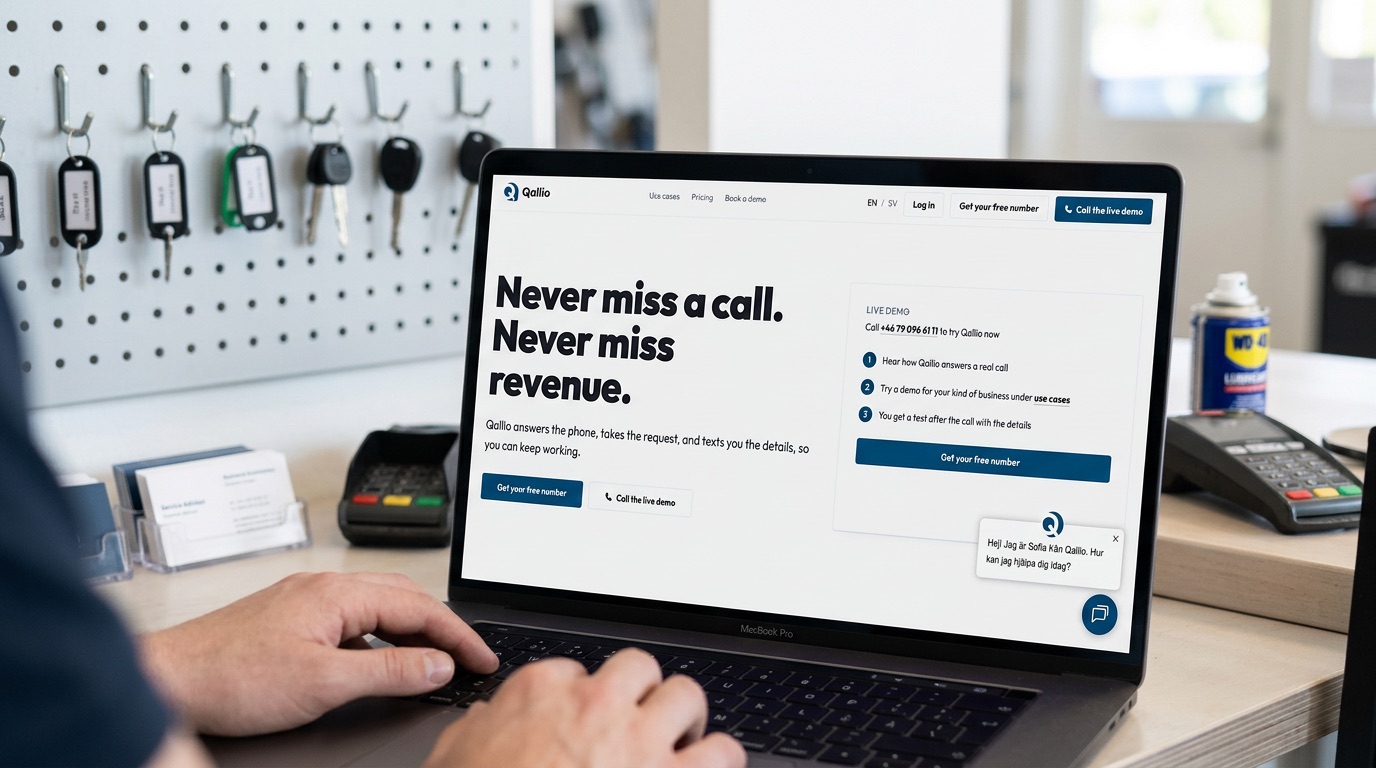
A note on what this actually fixes
This doesn't replace an actual diagnosis, and it can't give someone an exact price before a mechanic has looked at the car.
It can't tell a customer whether their specific vehicle is ready, since that depends on what's happening in your shop that day. And it isn't built for the rare call that needs a person making a real-time decision right now, someone stranded and needing immediate help.
What it fixes is more specific than just "answering the phone". Every caller hears the same calm, clear response, whether the shop is slow or slammed. That consistency is often what decides whether someone books with you or keeps calling around.
A missed call rarely feels like a missed job, until it is one
Most shops never find out how many calls went unanswered last week, or how many of those were from someone comparing two or three shops in real time, deciding based on who sounded like they had it together.
This isn't only an auto repair problem. Any small business where the team can't always stop what they're doing runs into the same gap, just with different tools in their hands.
A phone system for auto repair shops doesn't ask your team to choose between the car on the lift and the one calling about a noise it's been making. It answers the second one calmly and clearly, so the first one keeps getting worked on.
Start answering every call. Create your free Qallio account and be ready in under five minutes.
Frequently asked questions
Get started with Qallio
Turn on forwarding and let Qallio answer when you cannot.
More articles
Guide
Answering service, voicemail or AI receptionist: what fits a small business?
Three ways to handle the calls you can't take, what each one is good at, and how to test which fits your business in an afternoon.
Home services
How Home Service Businesses Can Manage Calls While on the Job
In home services, the person doing the work is often somewhere a phone cannot follow. See how Qallio answers every call so the job stays in progress and the caller doesn't disappear.