
Five Reasons to Use an AI Receptionist for Your Small Business
Missed calls cost small businesses more than most realise. Five reasons to use an AI receptionist, and how Qallio helps you get started in minutes.

The phone rings when no one can answer
A small business owner handles more in a single morning than most people manage in a full day. The phone rings while a customer is standing in front of you. While an order is being packed. While something in the kitchen or the workshop or the back room needs immediate attention.
Someone says they will get to it in a second. The call disappears. Nobody knows what was on the other end.
Most small businesses deal with this the same way every week. They accept a certain number of missed calls as part of how service works. The problem is that the customers on the other end do not accept it. They just move on.
An AI receptionist does not change how the business runs. It makes sure the calls that currently disappear into the background actually get answered.
Five reasons small businesses are making the switch
The five reasons below describe situations that come up in almost every small business, every week. None of them require a large team or a complicated system to address. They just require the phone to get answered when the team cannot.
1. Every missed call is a missed customer
When a potential customer calls and nobody answers, the outcome is almost always the same. They move on within the next few minutes.
Most people calling a small business are already close to a decision. They have looked at their options, picked a number, and made the call. If nobody answers, they do not wait. They call the next number on the list.
By the time a team member calls back, the customer has often already booked elsewhere. Not because of poor service or wrong pricing. Simply because someone else picked up first.
An AI receptionist answers every incoming call immediately, regardless of what else is happening inside the business. The customer gets a response at the moment they are ready to act, not thirty minutes later when someone has a free hand.
For small businesses that rely on inbound calls to bring in new customers, that window is everything.
2. Your team focuses on the work that needs them most
Most small businesses receive the same calls all day. Someone wants to know if you are open on Saturday. Someone wants to know where you are located. Someone wants to know if you are still taking new clients.
These calls take two minutes each. They are not difficult. They are just constant.
The real problem is not the time they take. It is the interruption. When a team member stops mid-task to answer a basic question, the customer standing in front of them notices. The conversation stalls. The attention splits.
Customers expect their query to be resolved on the first contact. For many small businesses, the reason is not a bad product or difficult staff. It is the moment when the person helping them stopped paying attention because the phone rang.
When routine calls are handled in the background, the team stays focused on what they were already doing. The phone still gets answered. The people in front of you get the attention they came for.
3. You handle peak periods without needing to hire for them
Call volume tends to arrive in concentrated windows: the lunch hour, the pre-holiday week, the same two hours every Friday. These are the moments when the phone rings most and the team is least available to answer it.
Hiring extra staff to cover those windows sounds like the obvious solution. In practice, it means recruiting, onboarding, scheduling, and carrying the full cost of employment well beyond the peak period itself. According to the U.S. Bureau of Labor Statistics, benefit costs alone average 29.8% of total compensation for private-industry workers. A new team member costs considerably more than their hourly rate suggests.
An AI receptionist handles multiple incoming calls simultaneously. During a surge, no caller reaches a busy signal because the team is at capacity. The same system that handles a quiet Tuesday handles a Friday peak without any adjustment.
| Hiring extra staff | Using Qallio | |
|---|---|---|
| Availability | Business hours | 24/7 |
| Simultaneous calls | One at a time | Multiple at once |
| Peak period coverage | Needs scheduling in advance | Automatic |
| Setup time | Weeks of recruiting and training | Five minutes |
| Cost structure | Salary plus benefits | Monthly subscription |
Focused on the work. Not waiting for the next call to interrupt it.

4. Every caller gets the same answer every time
Most people calling a small business do not want a complicated experience. They want one thing: an answer, on the first try.
Research cited in the 2025 CX Trends report found that 69.3% of customers expect their question to be resolved on the first contact. Not transferred. Not called back. Answered now.
An AI receptionist does not replace the warmth of a good phone manner. What it replaces is the experience of reaching nobody. Most customers are not disappointed that they spoke to an AI. They are disappointed when they have to call back, leave a voicemail, or wait for information they needed ten minutes ago.
The consistency is what matters. The greeting is the same on Monday morning and Friday evening. The information is accurate whether one person is working or five. The response does not change based on who is having a difficult day.
For small businesses, that reliability is part of what customers remember.
5. Getting started only takes minutes
Most small business owners have tried at least one system that turned out to be more complicated than it looked. The setup took longer than expected. The learning curve took longer than that. By the time it was working properly, the original problem had already cost a few more months.
That experience is what makes most people hesitant to try something new.
Research from the U.S. Chamber of Commerce shows that AI adoption among small businesses has grown sharply in recent years. The main driver is not complexity but simplicity: setup has become simple enough to do without a developer or an IT team.
An AI receptionist works the same way. You create an account using your email address, enter your business name and preferred language, and upload your menu or add your website. Qallio pulls what it needs from there. Most businesses are ready to receive calls in under five minutes, with no technical support required.
For businesses that want to keep their existing phone number, call forwarding handles it. Customers dial the same number they always have. Nothing changes on their end. The only difference they notice is that someone answers.
Where Qallio fits
Qallio is not a replacement for the team. It is what answers the phone when the team cannot.
During a busy period, the calls that would have gone unanswered get answered. Common questions about hours, availability, or services are handled immediately. Staff stay focused on the customers already in front of them. The people calling in still get through.
The system is configured around how the business actually works. Opening hours, service areas, appointment availability, and anything else callers regularly ask about. When a call requires a specific decision or falls outside the standard setup, Qallio takes a message and passes the details across.
Most businesses set it up once and do not need to think about it again. When something changes, updating the information takes a few minutes from the dashboard.
Getting started with Qallio
Getting started does not require any technical background or outside help.
1. Create your account. Create your free Qallio account using your email address and enter your business name and preferred language. Upload your menu, add your website, or write in the details you want Qallio to use on calls. The whole process takes around five minutes.
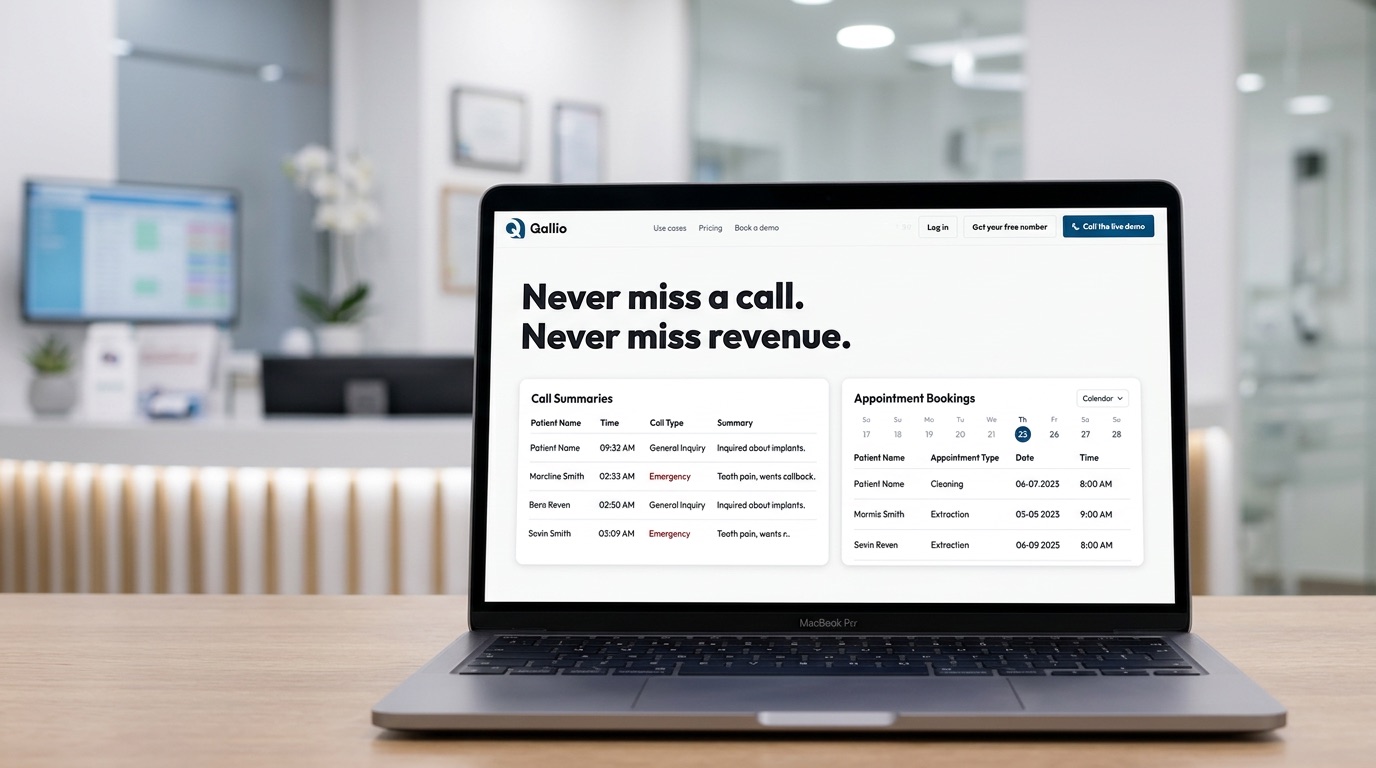
2. Go live. Once your information is submitted, Qallio generates your AI receptionist and assigns a dedicated phone number to your account. From that point, calls are being answered. You can review summaries, adjust settings, and update information directly from the dashboard at any time.
Which small businesses benefit most
An AI receptionist works well for any business where incoming calls follow a predictable pattern and the team is often too occupied to answer them consistently.
The types of businesses that see the most immediate difference:
- Restaurants and takeaway operations where calls arrive during service hours and the team is already at full capacity.
- Dental clinics and medical practices where front desk staff manage check-ins, insurance, and billing at the same time the phone rings.
- Salons and beauty businesses where the team is with clients and away from the reception desk for most of the day.
- Home services such as cleaning, repairs, and trades where the owner or team is on-site and cannot stop to answer the phone.
- Independent retailers and local shops where one person handles most things at once.
- Fitness studios and gyms where the desk is often unmanned during classes.
The situation, not the industry
The common thread is not the industry. It is the situation: the phone rings at the moment when nobody has a free hand to answer it.
An AI receptionist works best for calls that follow a clear pattern. When a call requires a specific clinical judgment, a sensitive personal situation, or a decision that changes day to day, staff should be involved. Qallio handles the calls that have straightforward answers. The team handles the ones that do not.
The first call sets the tone for everything that follows
A customer who cannot reach a small business during their first attempt rarely gives it a second chance. They move on quickly, and the business never sees a record of what was lost.
Five reasons, one underlying point. The phone rings when the team cannot answer it. That is not a failure. It is just how busy periods work. The question is whether the call gets answered anyway.
A phone answering solution for small businesses does not change how the business runs. It makes sure the calls that currently disappear into the background actually get through.
Start answering every call. Create your free Qallio account and be ready in under five minutes.
Frequently asked questions
Get started with Qallio
Turn on forwarding and let Qallio answer when you cannot.
More articles
Guide
Answering service, voicemail or AI receptionist: what fits a small business?
Three ways to handle the calls you can't take, what each one is good at, and how to test which fits your business in an afternoon.
Home services
How Home Service Businesses Can Manage Calls While on the Job
In home services, the person doing the work is often somewhere a phone cannot follow. See how Qallio answers every call so the job stays in progress and the caller doesn't disappear.