
How Home Service Businesses Can Manage Calls While on the Job
In home services, the person doing the work is often somewhere a phone cannot follow. See how Qallio answers every call so the job stays in progress and the caller doesn't disappear.
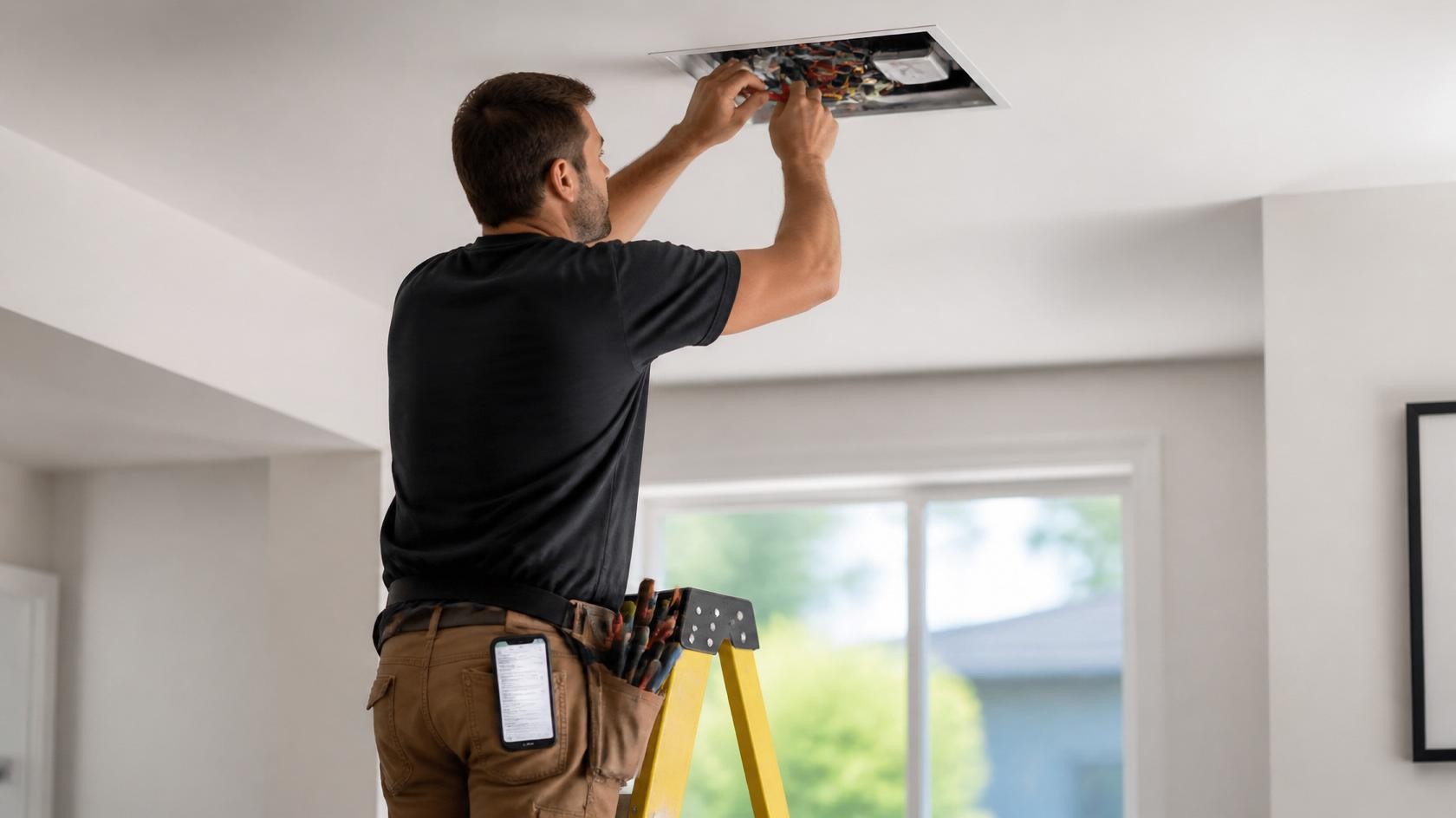
Not inconvenient. Physically impossible.
A plumber is on their back inside a crawl space, eighteen inches of clearance, both hands on a section of pipe that needs to stay exactly where it is. The phone rings. It is somewhere on their belt. Getting to it means stopping, backing out, standing up, and by that point the call has already ended.
An electrician is halfway up a ladder, both hands at a panel that is not fully isolated yet. The phone rings in their pocket. Reaching for it right now is not an option.
This is not inconvenient. It is physically impossible.
In home services, the person doing the work is often somewhere a phone cannot follow them. In a wall. On a roof. In a basement with no signal. In a space too tight to turn around in.
And the calls do not know that.
Why the problem is worse here than in most businesses
A restaurant has a counter. A repair shop has a workbench. A salon has a reception area. Home service businesses often have none of these things.
A sole trader plumber is the business. When they are under a sink fitting a new valve, there is no one else in the operation who could take the call. No colleague is one room over. No receptionist to transfer it to. No office to ring through to.
The call goes to voicemail. The voicemail sits there.
The noise problem makes it worse even when someone can physically get to their phone. A jackhammer breaking up concrete. A drill running through joists. A generator running nearby. Even on the rare occasion someone manages to answer, holding a conversation the person on the other end can actually hear is its own challenge.
Research on customer expectations consistently shows that people want an immediate response when they contact a service business. In home services, that expectation sits alongside a common reality: the person who could respond is somewhere they genuinely cannot be reached.
The calls that arrive with a clock running
Not all missed calls carry the same weight.
A missed reservation at a restaurant means the customer books somewhere else for Friday night. A missed call from someone with a burst pipe means water has been running for the duration of that missed call. And the next one. And the one after that.
Home service calls often arrive under urgency that has no equivalent in most other industries. A pipe has failed. The power is out. Something is making a noise it should not make.
These callers are not browsing. They are working through a list of tradespeople, calling each one in sequence. The first person who sounds capable and available is usually the one who gets the job.
A callback that arrives forty minutes later, when the person is back in their van, can sometimes still convert. But by then the customer has often already confirmed someone else. The decision got made based on who seemed most responsive in the moment they needed help.

Every kind of call arrives on the same number
A home service business receives calls that need completely different responses. There is no way to tell which is which before picking up.
- Someone calling to schedule a non-urgent job next week.
- Someone calling for a rough estimate before they decide whether to proceed.
- Someone calling to follow up on work that was done last month.
- And someone calling because something has gone wrong right now and they need a person.
One ring, four different outcomes
All of these arrive as a ringing phone. The urgent one does not announce itself differently from the scheduling one. During a job, when stopping is not possible, there is no way to triage first and then decide which calls are worth interrupting the work for.
The result is that all of them get the same outcome: voicemail. The scheduling call can wait. The estimate call can wait. The follow-up can wait. The emergency cannot, and it is the one that has already moved on by the time the callback happens.
How Qallio keeps the job in progress and the call answered
When a call comes in, Qallio answers it immediately. The tradesperson stays exactly where they are. The person calling gets a response.
For straightforward questions, that is the whole interaction. Service area, availability windows, rough pricing ranges, how to prepare for a visit. The caller gets a clear answer without anyone stopping what they are doing.
For a new job request, Qallio takes down what matters: the nature of the problem as the caller describes it, the address, and the best way to reach them back. That information lands in the dashboard the moment the call ends.
When the current job reaches a natural stopping point, the tradesperson has a complete record of who called and what they need, ready to follow up properly, not from a voicemail they half-listened to in a noisy van.
It is important to be clear about what this does not do. Qallio cannot assess whether a job is urgent enough to interrupt current work, because it does not know what the current job involves or how far through it the tradesperson is. For a genuine emergency, the goal is that the caller's details are captured immediately and clearly, so the tradesperson can see what came in and make that call themselves as quickly as possible.
- The tradesperson stays where the work is. No job gets abandoned mid-task because the phone rang.
- Every enquiry gets the same clear first response. A caller who reaches voicemail at three competing businesses and a real response at yours has already made a shortlist.
- New job requests are logged the moment they come in. Name, problem, address, contact details, written down clearly and waiting, instead of sitting in a voicemail that might not get listened to until the end of the day.
- After-hours calls still get an answer. Someone calling at seven in the evening about a problem that appeared after work does not reach a voicemail box. They get a response, their details are recorded, and the tradesperson sees it first thing.
Where Qallio fits
Qallio is not a dispatcher and it is not a job management system. It is what answers the phone when the tradesperson physically cannot, and makes sure the person who called does not disappear before a real conversation can happen.
It is set up around the specifics of the business: the service area, the types of work taken on, the hours, and how new enquiries should be handled. When a call needs a real assessment, a specific site visit, or a judgment call only the tradesperson can make, Qallio captures the details and passes them along. The conversation still happens. It just happens when there is a moment to have it properly, rather than shouted over a drill.
Hiring someone to cover the phone costs more than the hourly rate suggests, with benefit costs averaging close to 30% of total compensation. For a sole trader or small team, that is rarely a realistic option. Qallio provides the same coverage on a busy Tuesday as it does on a quiet Thursday afternoon, without adding to payroll.
Tradespeople who want to keep their existing number can do that through call forwarding. A call that goes unanswered on the current number forwards straight to Qallio. The customer dials the same number they always would.
Getting started with Qallio
Getting started does not require any technical background or outside help.
- Create your account. Create your free Qallio account using your email address and enter your business name and preferred language. Add the services you offer, your working area, your hours, and anything else you want Qallio to use on calls. The whole process takes around five minutes.
- Go live. Once your information is submitted, Qallio generates your AI receptionist and assigns a dedicated phone number to your account. From that point, calls are being answered. You can review summaries, adjust settings, and update information directly from the dashboard at any time.
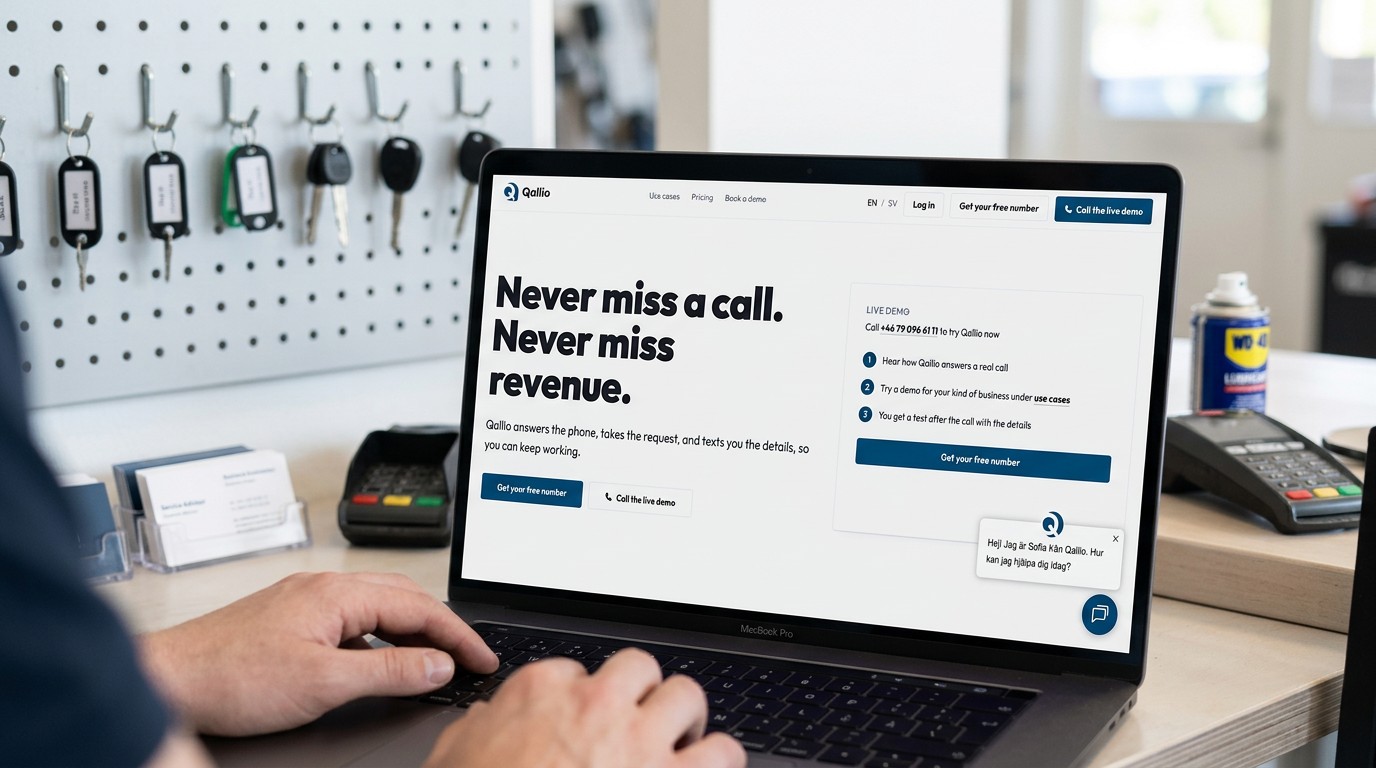
A note on what this actually fixes
This does not remove the need for a real conversation about a job. A plumber still needs to assess the problem before committing to a price. An electrician still needs to understand the scope before scheduling. Those conversations have to happen, and they have to happen with a person.
What this fixes is the gap that exists before those conversations. Every caller who tries to reach the business while the tradesperson is on a job gets a response instead of a voicemail. Their details are written down clearly. The conversation that needs to happen still happens, it just does not depend on the person being physically reachable at the exact moment the call comes in.
A call that goes to voicemail is a conversation that has to restart from zero
Most home service businesses never find out how many calls went unanswered on the days the jobs ran long. The callers who do not leave messages, who just move on to the next number, leave no trace.
A call management system for home service businesses does not change what the work involves or how long it takes. It changes what happens to the people who call while that work is in progress. They get through. Their details are captured. The conversation that turns into a job still has somewhere to start.
Start answering every call. Create your free Qallio account and be ready in under five minutes.
Frequently asked questions
Get started with Qallio
Turn on forwarding and let Qallio answer when you cannot.
More articles
Guide
Answering service, voicemail or AI receptionist: what fits a small business?
Three ways to handle the calls you can't take, what each one is good at, and how to test which fits your business in an afternoon.
Auto repair
Stop Losing Repair Jobs to Missed Calls During Busy Workshop Hours
A rushed answer can lose a job as fast as an unanswered call. See how Qallio keeps every caller hearing a calm, clear shop, without pulling anyone off the lift.